
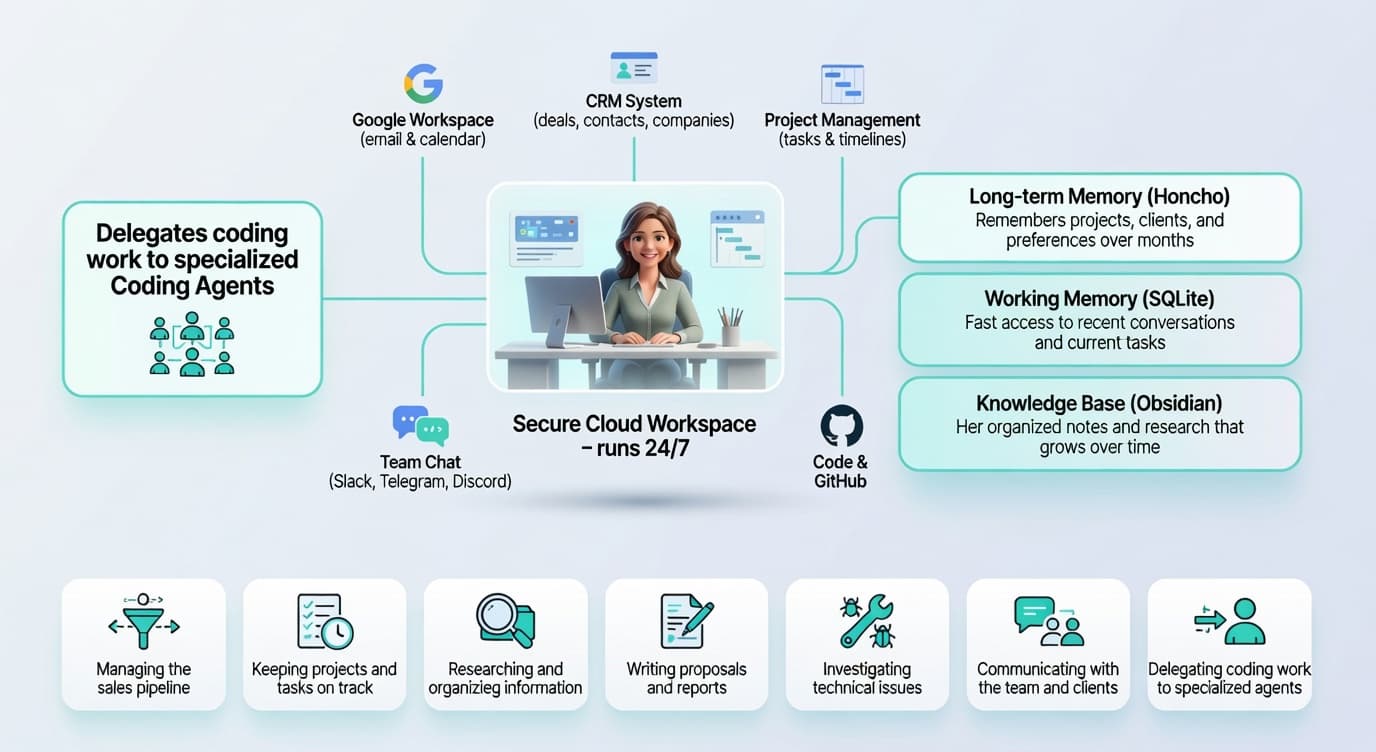
An AI chief of staff for founders helps keep operations moving by remembering context, triaging tasks, preparing decisions, and coordinating handoffs across business tools. Hawkfry uses AI this way internally, with Telegram-first approvals, Linear queues, scheduled pulses, and human gates so AI can speed up work without taking control away from the founder.
The Challenge
Founders are usually the glue.
They carry the context. They remember who asked for what. They know which client detail matters, which ticket is urgent, which email needs a careful tone, and which decision should not be automated.
That does not scale cleanly.
The problem is not a lack of tools. Most founder-led teams already have plenty: Slack or Telegram, Linear, GitHub, Google Workspace, CRM, meeting notes, documents, dashboards, and a dozen half-finished threads.
The problem is that the operating layer still lives in the founder's head. Every question, approval, follow-up, and loose end comes back to them. Important work moves, but only when they have the time and focus to reconnect the dots.
Hawkfry built an internal AI assistant to test a different model: an AI chief-of-staff layer that works where the founder already works, remembers operational context, prepares the next useful action, and knows when to stop for approval.
What We Built
Our AI assistant is not positioned internally as a magic autopilot. That would be lazy and unsafe.
It is an operating layer around real work.
For Hawkfry, that means AI can support founder operations across a few practical surfaces:
1. Telegram-first executive support
We can ask our AI assistant for help in the flow of the day. The interaction is short, direct, and decision-led.
It can draft replies, summarise context, check what changed, inspect operational systems, and prepare the next action. Where approval matters, the AI asks for it. Where a task is safe and already authorised, it acts.
This keeps the founder interface simple: one thread, useful answers, clear evidence, and no dashboard pilgrimage.
2. Linear queues for work that should not be forgotten
We can tag work for our AI assistant in Linear. Its scheduled queue checks labelled issues, reads the full context, decides whether the work is safe to do autonomously, and writes progress back to Linear as the operational source of truth.
The point is not hidden automation. The point is visible operational continuity.
A good run leaves evidence: what ticket was processed, what status changed, what branch or artifact was created, what validation ran, what is blocked, and what we need to decide next.
3. Skills that make repeated work better
The assistant can use reusable skills for known workflows: Linear ticket handling, GitHub PR handoffs, document drafting, client email drafting, meeting-note recall, and other operational tasks.
That gives the system a memory of how Hawkfry likes work done. It also gives the founder a way to improve the operating layer over time. When a workflow is wrong or incomplete, the skill can be patched rather than relying on someone remembering the same preference next week.
4. Context recall across operating systems
Founder work is rarely contained in one app.
A single decision may touch a Linear issue, a GitHub PR, a meeting note, a CRM record, a draft email, and an old preference the founder gave in a previous conversation.
The assistant's job is to pull the right context into the decision, not to make unsupported leaps. It can inspect source systems, search previous sessions, read notes, and separate evidence from assumptions.
That distinction is important. Good AI operations are not about sounding certain. They are about being clear on what is known, what is inferred, and what needs human confirmation.
5. Human approval gates for risky work
Some actions should never be automated away.
Our AI assistant does not merge code. It does not run production or shared-schema migrations without explicit approval. It does not publish sensitive material or provide team data without permission. It does not treat elevated tool access as permission to do irreversible things.
This is the pattern Hawkfry believes in: speed with control.
AI should remove drag from the founder's day, not create operational risk.
Why It Worked
The value is in the operating design.
Hawkfry built the workflow around five principles:
- Meet the founder where they already work. Telegram is the quick interface. Linear is the source of task truth. GitHub, CRM, notes, and docs stay as systems of record.
- Make evidence visible. The assistant reports what it checked, what it changed, and what remains uncertain.
- Use skills. Repeatable workflows become procedures it can follow and improve.
- Prefer reversible actions. Draft, prepare, branch, comment, and checkpoint before doing anything risky.
- Keep humans in charge. Approval gates are not a weakness. They are the safety system that makes practical AI useful.
This creates a different feel from a generic chatbot.
A chatbot answers. Our AI assistant is designed to deliver outputs through the tooling where work already happens.
Sometimes that means drafting a client email and waiting for approval. Sometimes it means turning a Linear ticket into a pull request handoff. Sometimes it means finding the relevant meeting context before we make a decision. Sometimes it means refusing to act because the safe next step needs a human.
That is what a useful AI chief of staff should do.
Build Your Own AI Operating Layer
Want your own AI assistant? Let's design the operating layer your team actually needs.